





Dry Fire Diagnostic vs. Live Fire?
Dry Fire Diagnostic vs. Live Fire?
Understanding the Difference Will Make You a Better Shooter
Many shooters ask the same question:
“If I practice dry fire, why do my shots still fall apart at the range?”
The short answer is this:
Dry fire diagnostics and live fire diagnostics are not the same thing—and they are not supposed to be.
They serve different purposes, reveal different problems, and together form the fastest path to real improvement.
Dry Fire Diagnostics: The Truth About Your Mechanics
Dry fire removes recoil, noise, and blast from the equation. What’s left is you.
That’s why dry fire diagnostics are so powerful.
What Dry Fire Reveals Best
-
Trigger control errors
-
Anticipation (flinch before the shot)
-
Wrist breaking at the moment of trigger press
-
Sight focus errors
-
Grip inconsistency before recoil
Without recoil, the gun only moves if the shooter moves it.
That makes dry fire the most honest diagnostic environment possible.
Why Dry Fire Is the Best Starting Point
-
No ammo cost
-
No range required
-
Safe, repeatable, and controlled
-
Errors are clear and consistent
-
Ideal for home training
In short, dry fire finds the root cause.
Live Fire Diagnostics: Validation Under Recoil
Live fire introduces recoil, blast, noise, and time pressure. These factors change how the body reacts.
Live fire is not about discovering new fundamentals - it’s about testing whether fundamentals survive recoil.
What Live Fire Reveals Best
-
Recoil management breakdown
-
Grip collapses under impulse
-
Shot recovery timing
-
Cadence issues
-
Stress-induced return of flinch
Live fire answers a different question:
“Can I maintain correct mechanics when the gun actually fires?”
Why Live Fire Can Hide the Real Problem
Many shooters assume:
“I missed because of recoil.”
In reality:
-
Trigger jerk may happen before recoil
-
Anticipation may dip the muzzle before ignition
-
Grip tension may change as the trigger breaks
Recoil often masks the true cause of the miss.
That’s why diagnosing fundamentals using live fire alone is slow, expensive, and frustrating.
Dry Fire vs Live Fire: Side-by-Side
| Dry Fire Diagnostic | Live Fire Diagnostic | |
|---|---|---|
| Recoil | None | Present |
| Cost | Low Cost | Ammo required |
| Safety | Maximum | Range dependent |
| Best for | Root-cause errors | Stress validation |
| Trigger errors | Clear | Often masked |
| Flinch detection | Very high | Inconsistent |
| Learning speed | Fast | Slower |
The Correct Training Order
(Most Shooters Get This Wrong)
Many shooters go straight to live fire and hope repetition fixes the problem.
The smarter approach is:
Step 1: Dry Fire Diagnostic
Identify:
-
Your primary mistake
-
Your secondary pattern
-
Your consistency level
Step 2: Corrective Dry Fire
Apply:
-
One correction
-
One focus point
-
One improvement goal
Step 3: Live Fire Validation
Confirm:
-
Whether the correction survives recoil
-
Whether the grip or the stance needs adjustment
Dry fire fixes the problem.
Live fire confirms the fix.
How a Simulator Makes This Even More Powerful
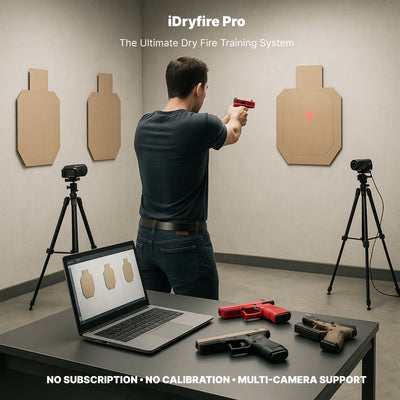
Modern laser and camera-based simulators take dry fire diagnostics to another level by:
-
Automatically identifying error patterns
-
Grouping shots by mistake type
-
Explaining why shots miss
-
Tracking improvement over time
Instead of guessing, shooters get objective feedback - the same way athletes use performance data in other sports.
The Big Takeaway
Dry fire and live fire are not competitors.
They are partners.
Dry fire shows you what’s wrong.
Live fire shows you whether it stays fixed.
If you skip dry fire diagnostics, you waste ammo.
If you skip live fire validation, you miss confidence.
The shooters who improve fastest understand - and use -both correctly.
Final Thought
If you want to shoot better, don’t just practice more.
Practice smarter.
Leave a comment